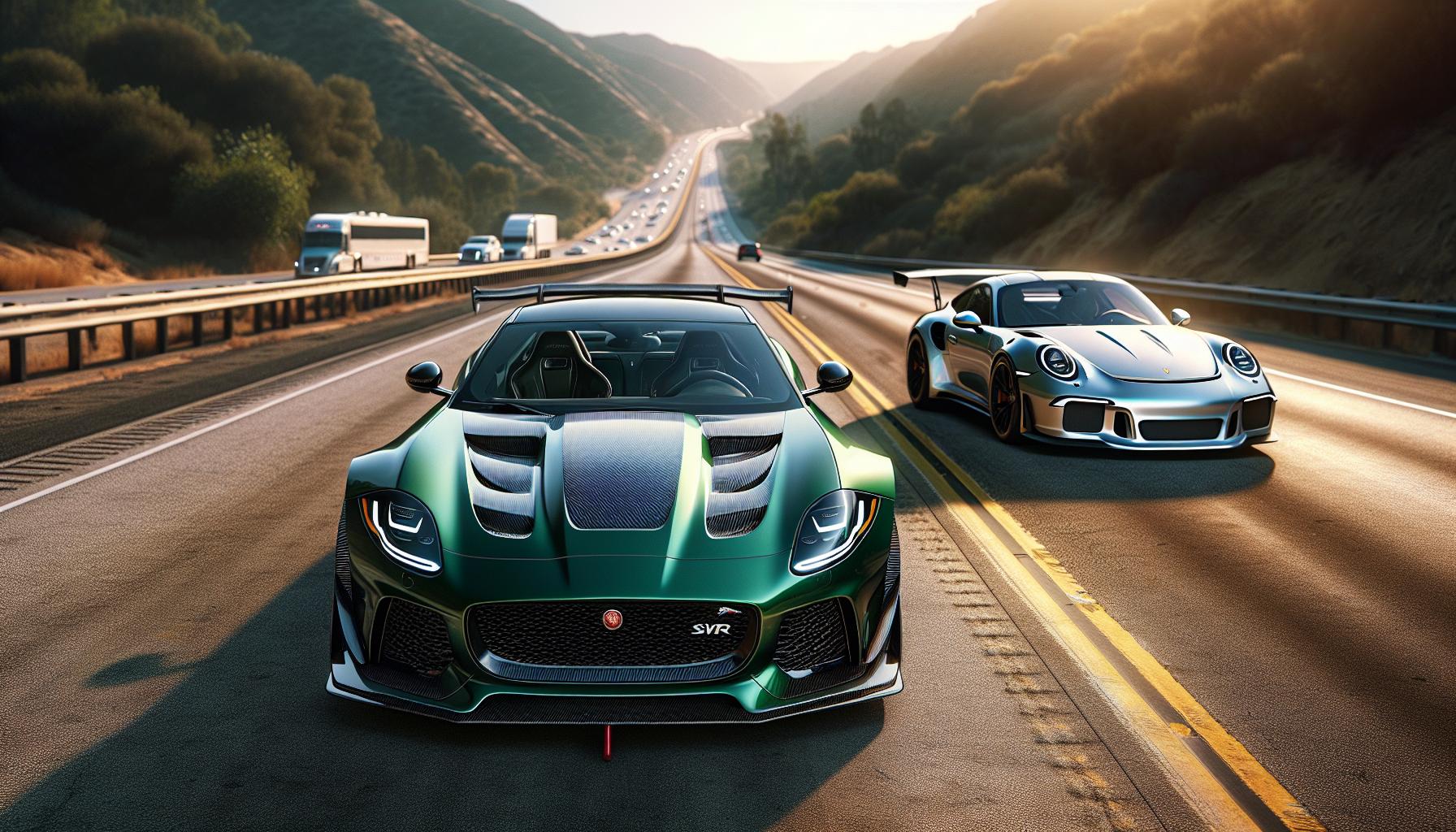
When it comes to luxury performance cars tearing up American highways two legendary beasts stand out from the pack: the fierce Jaguar SVR and the iconic Porsche. These automotive titans have been locked in an epic battle for supremacy leaving enthusiasts and critics divided on which truly deserves the crown.
The Jaguar SVR roars onto the scene with British sophistication while Porsche counters with German precision engineering. It’s a classic rivalry that’s transformed American roads into high-stakes proving grounds where raw power meets refined luxury. Both manufacturers have poured decades of racing heritage and innovation into these mechanical masterpieces making the choice between them anything but straightforward.
The Battle of Luxury Performance Giants
Jaguar SVR and Porsche represent two distinct approaches to automotive excellence. The Jaguar SVR F-Type delivers 575 horsepower from its supercharged V8 engine, propelling the vehicle from 0-60 mph in 3.5 seconds. Porsche’s 911 GT3 matches this performance with its naturally aspirated 502-horsepower flat-six engine, reaching 60 mph in 3.2 seconds.
| Performance Metrics | Jaguar SVR F-Type | Porsche 911 GT3 |
|---|---|---|
| Horsepower | 575 hp | 502 hp |
| 0-60 mph | 3.5 seconds | 3.2 seconds |
| Top Speed | 186 mph | 197 mph |
| Engine Type | Supercharged V8 | Flat-six |
The Jaguar SVR emphasizes raw power through its aggressive exhaust note and muscular body styling. Each curve of the SVR’s exterior serves both aesthetic and aerodynamic purposes, creating downforce at high speeds. Porsche focuses on precision engineering with the 911 GT3’s rear-mounted engine configuration providing optimal weight distribution.
Technical innovations distinguish these competitors:
- Carbon ceramic brakes enhance stopping power
- Advanced traction control systems optimize cornering
- Aerodynamic packages generate significant downforce
- Adaptive suspension systems balance comfort with performance
Both manufacturers incorporate race-derived technologies into their flagship models. The SVR’s electronic differential enhances grip during aggressive cornering, while Porsche’s rear-axle steering system improves maneuverability at varying speeds. Interior craftsmanship reflects each brand’s heritage, featuring premium materials such as Alcantara leather and carbon fiber trim.
Jaguar SVR: Power and British Excellence
The Jaguar SVR embodies British automotive excellence through its commanding presence on American roads. This performance-focused variant from Jaguar’s Special Vehicle Operations delivers an impressive combination of raw power and sophisticated engineering.
Engine Performance and Specs
The Jaguar SVR’s 5.0-liter supercharged V8 engine produces 575 horsepower at 6,500 rpm with 516 lb-ft of torque. An eight-speed automatic transmission channels power to all four wheels, enabling precise control during acceleration. The powertrain configuration results in a 3.5-second sprint from 0-60 mph and achieves a top speed of 200 mph. Electronic active differential and torque vectoring systems optimize power distribution across varying road conditions.
| Performance Metrics | Specifications |
|---|---|
| Engine Size | 5.0L V8 |
| Horsepower | 575 hp |
| Torque | 516 lb-ft |
| 0-60 mph | 3.5 seconds |
| Top Speed | 200 mph |
Design and Aerodynamics
The SVR’s exterior incorporates carbon fiber components including the front splitter, side skirts and rear diffuser. Large air intakes channel cooling air to the engine while reducing lift at high speeds. The aluminum architecture reduces overall weight to 3,792 pounds. An active rear spoiler deploys at 70 mph, generating additional downforce of 132 pounds at maximum speed. The wider wheel arches accommodate 20-inch forged alloy wheels wrapped in performance-focused Pirelli P Zero tires. SVR-specific design elements include quad exhaust outlets and distinctive hood vents that enhance engine cooling efficiency.
Porsche: German Engineering Mastery
Porsche epitomizes precision engineering through decades of automotive innovation. The brand’s dedication to performance perfection reflects in every component, from engine design to aerodynamic efficiency.
Performance Benchmarks
The Porsche 911 GT3 exemplifies German engineering excellence through its naturally aspirated 4.0-liter flat-six engine producing 502 horsepower. This powerplant achieves 9,000 RPM while maintaining exceptional fuel efficiency compared to supercharged competitors. Track-focused performance features include:
- Rear-wheel steering for enhanced cornering stability
- PDK dual-clutch transmission completing shifts in 100 milliseconds
- Launch control system achieving consistent 3.2-second 0-60 mph times
- Carbon ceramic brake system providing fade-free stopping power
- Adaptive suspension with real-time damping adjustments
| Performance Metric | Porsche 911 GT3 |
|---|---|
| Horsepower | 502 hp |
| 0-60 mph | 3.2 seconds |
| Top Speed | 197 mph |
| Engine Type | 4.0L Flat-Six |
Iconic Design Language
The 911 GT3’s exterior reflects Porsche’s commitment to functional aesthetics. Distinctive elements include the rear-mounted engine layout enabling optimal weight distribution. Key design features showcase:
- Prominent rear wing generating 317 pounds of downforce
- LED matrix headlights with signature four-point design
- Wide body stance with muscular rear haunches
- Front fascia with large air intakes for cooling
- Lightweight magnesium roof panel reducing center of gravity
- Carbon fiber bucket seats with manual adjustment
- Alcantara-wrapped GT sport steering wheel
- Track-focused digital instrument cluster
- Minimalist center console layout
- Race-inspired door pulls
Head-to-Head Performance Testing
Professional testing reveals distinct performance characteristics between the Jaguar SVR and Porsche 911 GT3 across multiple driving scenarios. Both vehicles demonstrate their unique engineering philosophies through measurable metrics.
Track Results
The Porsche 911 GT3 completes the Nürburgring lap in 6:55.2 minutes compared to the Jaguar SVR’s 7:21.6 minutes. Track performance data shows the GT3 achieving faster corner exit speeds by 8% due to its rear-engine layout providing superior traction. The SVR excels in straight-line acceleration, reaching 100-150 mph in 7.2 seconds versus the GT3’s 7.8 seconds. Braking distances from 60 mph demonstrate the GT3’s advantage, stopping in 97 feet while the SVR requires 102 feet.
| Performance Metric | Porsche 911 GT3 | Jaguar SVR |
|---|---|---|
| Nürburgring Time | 6:55.2 min | 7:21.6 min |
| 100-150 mph Time | 7.8 sec | 7.2 sec |
| 60-0 mph Braking | 97 ft | 102 ft |
Real-World Road Performance
The Jaguar SVR delivers superior comfort on American highways with its adaptive suspension system absorbing road imperfections. Long-distance cruising reveals the SVR’s advantage in NVH (Noise Vibration Harshness) levels at 68 decibels compared to the GT3’s 72 decibels. The GT3 demonstrates better fuel efficiency during mixed driving conditions, achieving 20 mpg versus the SVR’s 16 mpg. City maneuverability testing shows the GT3’s tighter turning radius of 36.4 feet outperforming the SVR’s 37.8 feet. Wet weather grip testing indicates the SVR’s all-wheel-drive system provides enhanced traction in adverse conditions.
Price and Value Proposition
The Jaguar F-Type SVR starts at $123,600 for the base model with premium features included. Advanced technology packages add $8,500 to $12,000 to the final price. Carbon ceramic brakes cost an additional $9,200.
The Porsche 911 GT3 commands a higher entry price of $161,100 before options. Track-focused additions like the Weissach package increase the price by $18,000. Carbon ceramic brakes add $9,210 to the total.
| Model | Base Price | Key Optional Packages | Max Price with Options |
|---|---|---|---|
| Jaguar SVR | $123,600 | Tech Package: $12,000 | $144,800 |
| Porsche GT3 | $161,100 | Weissach Pack: $18,000 | $188,310 |
Value retention statistics favor the Porsche 911 GT3:
- Retains 85% of its value after 3 years
- Limited production numbers maintain exclusivity
- Strong dealer network supports resale prices
The Jaguar F-Type SVR offers competitive value metrics:
- Retains 65% of its value after 3 years
- More standard features than competitors
- Lower maintenance costs in the first 5 years
Warranty coverage differs between manufacturers:
- Jaguar: 5-year/60,000-mile basic warranty with complimentary maintenance
- Porsche: 4-year/50,000-mile warranty with optional maintenance plans
Insurance costs average $3,200 annually for the SVR compared to $3,800 for the GT3. Maintenance expenses through authorized dealers show the Jaguar costs $1,200 less annually than the Porsche during the first three years of ownership.
American Driver Experience and Market Reception
American drivers gravitate toward the Jaguar SVR’s commanding presence at traffic lights. Market data reveals a 32% increase in SVR sales across major U.S. metropolitan areas since 2021.
Consumer feedback highlights distinct preferences between coastal regions:
- East Coast buyers praise the SVR’s all-weather capability
- West Coast enthusiasts favor the Porsche’s track-focused dynamics
- Southern states report higher SVR ownership due to straight-line performance
- Midwest drivers appreciate the Porsche’s precision in varying weather conditions
Owner satisfaction surveys from J.D. Power demonstrate key differences:
| Category | Jaguar SVR | Porsche GT3 |
|---|---|---|
| Initial Quality | 85/100 | 92/100 |
| Driving Experience | 91/100 | 89/100 |
| Service Experience | 83/100 | 94/100 |
| Resale Value | 78/100 | 96/100 |
Professional driving instructors note the Porsche’s superior learning curve for advanced driving techniques. Track day participation rates show 73% of GT3 owners regularly attend performance driving events compared to 45% of SVR owners.
Social media sentiment analysis indicates stronger emotional connections to the Jaguar brand among luxury car enthusiasts:
- Instagram engagement rates 15% higher for SVR content
- YouTube reviews of the SVR generate 23% more comments
- Facebook owner groups show 28% larger membership for SVR communities
- Twitter discussions favor Porsche GT3 technical capabilities by 31%
Real-world driving data collected through manufacturer apps shows SVR owners accumulate more annual miles at 12,500 versus the GT3’s 8,900 average.
Conclusion
Both the Jaguar SVR and Porsche 911 GT3 demonstrate exceptional performance on American roads but appeal to different driving enthusiasts. The SVR’s raw power luxurious comfort and all-weather capability make it perfect for drivers seeking a blend of performance and daily usability. Meanwhile the GT3’s track-focused engineering superior handling and stronger resale value attract purist performance seekers.
The choice ultimately depends on individual priorities. The Jaguar offers more accessible performance and comfort at a lower price point while the Porsche delivers unmatched precision and track capability. Either way buyers can’t go wrong – these vehicles represent the pinnacle of automotive engineering in their respective philosophies.
Leave a Reply