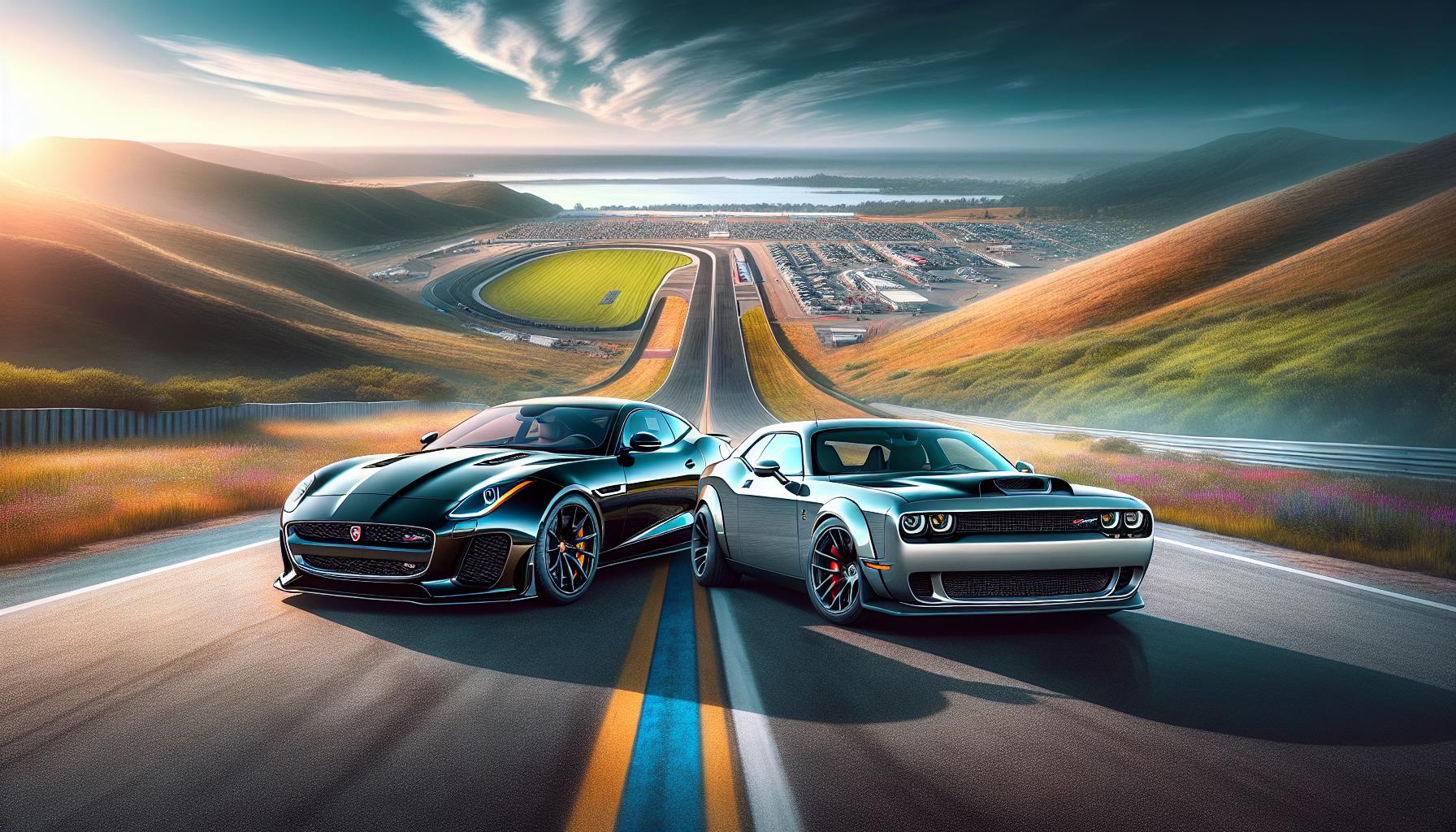
The age-old battle between European sophistication and American brawn takes center stage as Jaguar’s SVR lineup faces off against Detroit’s finest muscle cars. It’s like watching a sophisticated British gentleman in a tailored suit challenge a rough-and-tumble cowboy to an arm-wrestling match.
While American muscle cars have long dominated the quarter-mile with their raw power and thunderous engines the Jaguar SVR series brings a different flavor to the high-performance arena. These British beasts combine refined luxury with track-ready performance creating a unique blend that’s both exhilarating and elegant. As enthusiasts debate which approach reigns supreme the real question remains: Can British engineering match the tried-and-true American formula of “there’s no replacement for displacement”?
Understanding the Jaguar SVR Legacy
Jaguar’s Special Vehicle Racing (SVR) division represents the pinnacle of British performance engineering. This elite department transforms standard Jaguar models into high-performance machines through advanced technological innovations.
Key Performance Specifications
The Jaguar F-Type SVR delivers 575 horsepower from its supercharged 5.0-liter V8 engine. The powertrain accelerates from 0-60 mph in 3.5 seconds with a top speed of 200 mph. Additional performance metrics include:
| Specification | Value |
|---|---|
| Torque | 516 lb-ft |
| Quarter Mile | 11.7 seconds |
| Carbon Fiber Components | 176 lbs reduction |
| Transmission | 8-speed QuickShift |
British Engineering Excellence
SVR engineers incorporate aerodynamic developments from Formula 1 racing into each vehicle design. The carbon fiber active rear wing reduces lift by 105 pounds at top speed. Advanced lightweight alloy construction combines with electronically controlled suspension systems for precise handling. The Quickshift transmission delivers gear changes in 200 milliseconds through all-wheel-drive architecture. SVR models feature a sophisticated Electronic Active Differential that optimizes torque distribution between rear wheels for enhanced cornering capability.
American Muscle Car Contenders
American muscle cars represent the pinnacle of domestic performance engineering with their aggressive styling raw power. These three iconic models stand as formidable opponents to Jaguar’s SVR lineup.
Dodge Challenger Hellcat
The Dodge Challenger Hellcat unleashes 717 horsepower from its supercharged 6.2-liter HEMI V8 engine. Accelerating from 0-60 mph in 3.7 seconds, this beast delivers 656 lb-ft of torque through an 8-speed automatic transmission. The Challenger Hellcat reaches a top speed of 199 mph with additional performance features including Brembo six-piston front brakes, competition-tuned suspension, and SRT Drive Modes for customizable performance settings.
Ford Mustang Shelby GT500
The Shelby GT500 generates 760 horsepower from its supercharged 5.2-liter V8 powerplant. Ford’s most powerful production car ever clocks 0-60 mph in 3.3 seconds with 625 lb-ft of torque. The GT500 features a TREMEC 7-speed dual-clutch transmission, MagneRide active suspension, and aerodynamic components producing 550 pounds of downforce at top speed.
Chevrolet Camaro ZL1
The Camaro ZL1 packs 650 horsepower from its supercharged 6.2-liter LT4 V8 engine. Producing 650 lb-ft of torque, the ZL1 sprints to 60 mph in 3.5 seconds through a 10-speed automatic transmission. Magnetic Ride Control suspension, electronic limited-slip differential, and Performance Traction Management system optimize handling capabilities while Brembo brakes provide track-ready stopping power.
| Model | Horsepower | Torque (lb-ft) | 0-60 mph |
|---|---|---|---|
| Challenger Hellcat | 717 | 656 | 3.7s |
| Shelby GT500 | 760 | 625 | 3.3s |
| Camaro ZL1 | 650 | 650 | 3.5s |
Head-to-Head Performance Comparison
A comprehensive analysis of performance metrics reveals distinct advantages between Jaguar’s SVR models and American muscle cars. Direct comparisons across multiple performance categories highlight the unique strengths of each contender.
Acceleration and Top Speed
The Shelby GT500 leads the acceleration battle with a 3.3-second 0-60 mph time, edging out the Jaguar F-Type SVR’s 3.5-second sprint. Top speed rankings place the F-Type SVR at the front with 200 mph, surpassing the Challenger Hellcat’s 199 mph mark. The Camaro ZL1 matches the SVR’s 0-60 mph time but reaches a lower top speed of 198 mph. Each vehicle employs different approaches to achieve these numbers: the SVR uses advanced aerodynamics while American muscle cars rely on raw power output.
Handling and Track Performance
Track testing demonstrates the F-Type SVR’s superior cornering abilities, generating 1.02g of lateral grip through its sophisticated Electronic Active Differential. The Camaro ZL1 matches this performance with its Magnetic Ride Control suspension, achieving similar g-forces. The GT500’s track-focused suspension delivers precise handling with 1.00g of lateral grip, while the Hellcat produces 0.97g. The SVR’s lighter chassis weight of 3,759 pounds enhances its agility compared to the heavier American counterparts.
| Vehicle Model | Quarter Mile Time | Trap Speed |
|---|---|---|
| F-Type SVR | 11.7 seconds | 124 mph |
| Shelby GT500 | 11.3 seconds | 131 mph |
| Challenger Hellcat | 11.8 seconds | 126 mph |
| Camaro ZL1 | 11.5 seconds | 127 mph |
The Shelby GT500 dominates quarter-mile runs with an 11.3-second time. The Camaro ZL1 follows with 11.5 seconds, while the F-Type SVR clocks 11.7 seconds. The Challenger Hellcat rounds out the group at 11.8 seconds. These times reflect each vehicle’s power delivery characteristics through their respective transmission systems.
Interior Luxury and Technology
The interior battle between Jaguar SVR and American muscle cars highlights distinct approaches to luxury and technology integration. These performance vehicles showcase unique cabin designs that reflect their brand heritage and target audience preferences.
Premium Features Comparison
The Jaguar F-Type SVR’s cabin features Windsor leather performance seats with SVR embossing quilted patterns throughout. Carbon fiber trim adorns the center console door panels while a sueded cloth headliner enhances the premium feel. The American competitors offer varying levels of luxury with the Shelby GT500 featuring Recaro racing seats leather-wrapped surfaces plus authentic aluminum accents. The Challenger Hellcat includes Laguna leather seats with embossed SRT logos while the Camaro ZL1 sports RECARO performance seats with microfiber inserts sueded steering wheel plus customizable ambient lighting.
Infotainment Systems
The F-Type SVR incorporates a 10-inch TouchPro infotainment system with connected navigation smartphone integration plus a 12.3-inch digital instrument cluster. Dodge equips the Hellcat with an 8.4-inch Uconnect system featuring Performance Pages for real-time data. The Shelby GT500’s SYNC 4 system operates through a 12-inch touchscreen offering track apps wireless connectivity plus over-the-air updates. Chevrolet’s Camaro ZL1 utilizes an 8-inch MyLink interface with Performance Data Recorder allowing drivers to capture track sessions review telemetry data analyze driving techniques.
Price Point and Value Proposition
The price comparison between Jaguar SVR models and American muscle cars reveals distinct market positioning. The F-Type SVR commands $123,600 as its base price, positioning it in the premium performance segment. Dodge offers the Challenger Hellcat at $72,900, Ford prices the Shelby GT500 at $79,420, and Chevrolet sets the Camaro ZL1 at $69,000.
| Model | Base Price | Key Value Features |
|---|---|---|
| Jaguar F-Type SVR | $123,600 | Premium materials, advanced aerodynamics, all-wheel drive |
| Shelby GT500 | $79,420 | Highest horsepower, track-focused features |
| Challenger Hellcat | $72,900 | Spacious interior, retro styling, daily usability |
| Camaro ZL1 | $69,000 | Magnetic ride control, track performance |
Cost per horsepower calculations demonstrate interesting value metrics across these vehicles:
- Jaguar F-Type SVR: $215 per hp (575 hp)
- Shelby GT500: $104 per hp (760 hp)
- Challenger Hellcat: $102 per hp (717 hp)
- Camaro ZL1: $106 per hp (650 hp)
American muscle cars offer more raw power per dollar, yet the F-Type SVR justifies its premium through:
- Carbon fiber components
- Advanced all-wheel-drive system
- Premium interior materials
- Sophisticated aerodynamic technology
- European brand prestige
The resale value analysis shows American muscle cars maintaining 58% to 62% of their value after three years. Jaguar F-Type SVR models retain 52% of their original value, reflecting typical luxury vehicle depreciation patterns.
Real-World Drivability
Daily practicality differs significantly between the Jaguar SVR and American muscle cars. Each vehicle presents unique characteristics that impact their usability as everyday transportation.
Daily Driver Potential
The Jaguar F-Type SVR excels in daily driving scenarios with adaptive suspension that automatically adjusts between comfort and sport modes. Its all-wheel-drive system provides confident handling in various weather conditions. The cabin offers superior noise insulation at 67 decibels during highway cruising. Storage capacity includes a 14.4 cubic feet trunk in the coupe version.
American muscle cars demonstrate varying degrees of daily usability. The Challenger Hellcat leads with 16.2 cubic feet of cargo space plus a spacious rear seat. The Shelby GT500’s firm suspension creates a stiffer ride on city streets. The Camaro ZL1 presents visibility challenges due to its high beltline design.
Fuel Economy
The fuel consumption figures reveal significant differences between these high-performance vehicles:
| Vehicle Model | City MPG | Highway MPG | Combined MPG |
|---|---|---|---|
| Jaguar F-Type SVR | 16 | 24 | 19 |
| Challenger Hellcat | 13 | 22 | 16 |
| Shelby GT500 | 12 | 18 | 14 |
| Camaro ZL1 | 14 | 20 | 16 |
The Jaguar F-Type SVR achieves better fuel efficiency through advanced engine management systems. Its cylinder deactivation technology reduces fuel consumption during highway cruising. Premium fuel requirements exist for all models to maintain optimal performance.
Conclusion
The battle between Jaguar’s SVR lineup and American muscle cars showcases two distinct approaches to high-performance vehicles. While American muscle cars dominate with raw power and attractive price points Jaguar SVR models excel in refinement luxury and technological innovation.
Each contender brings unique strengths to this horsepower showdown. The Shelby GT500 rules the quarter-mile the Jaguar F-Type SVR claims the top speed crown and all deliver impressive handling capabilities. The price premium for British engineering buys more than just performance – it delivers a sophisticated driving experience that seamlessly blends comfort with capability.
This rivalry proves there’s no single formula for automotive excellence. Whether choosing British precision or American muscle drivers win either way with these exceptional performance machines.
Leave a Reply