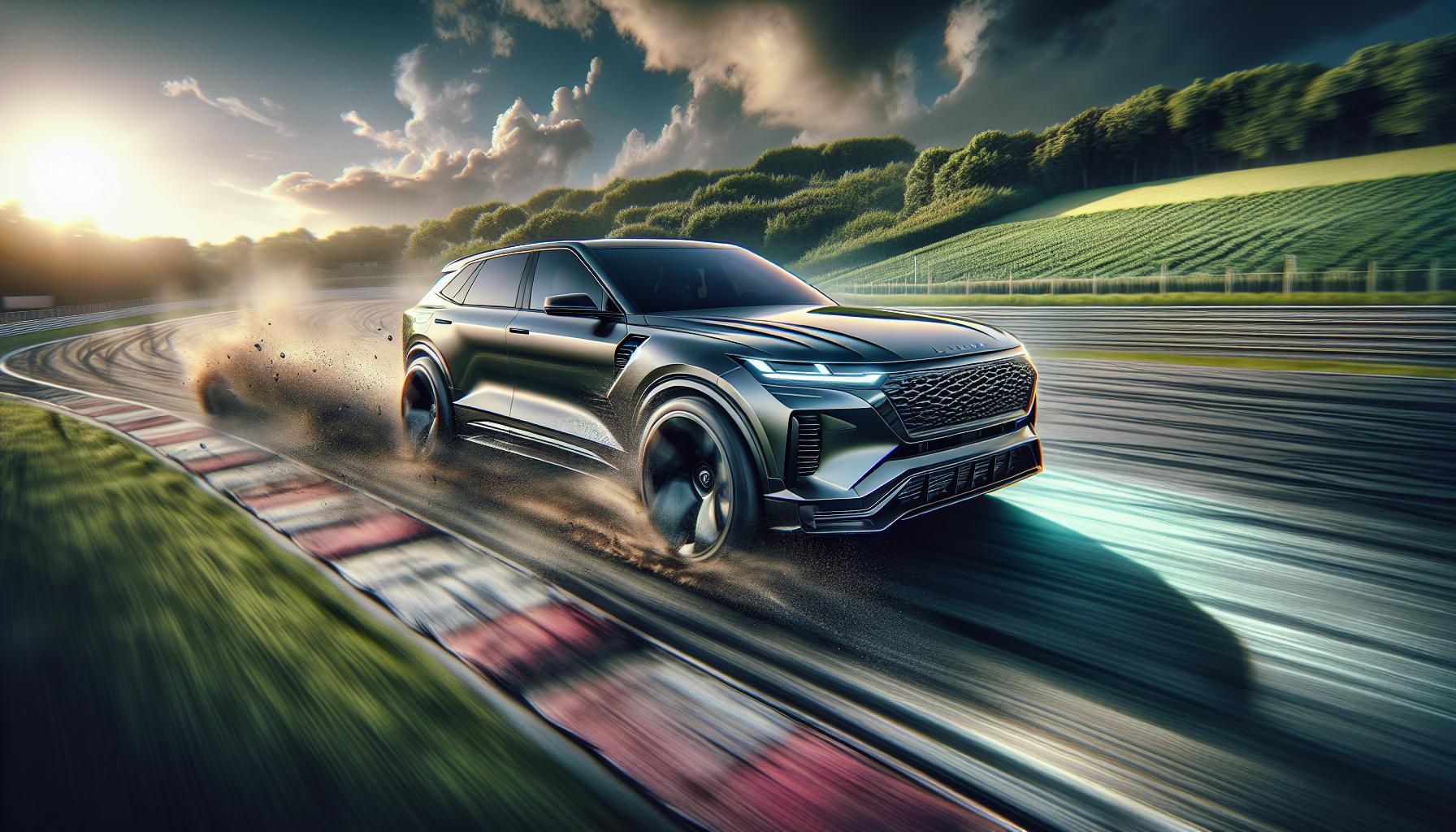
When most people think of lightning-fast supercars, their minds jump straight to the usual suspects – Ferrari, Lamborghini, and McLaren. But there’s a British cat that’s been quietly sharpening its claws, ready to pounce on these exotic predators. Enter the Jaguar SVR, the unlikely hero in this high-octane tale.
In a world where 0-60 times are the ultimate bragging rights, Jaguar’s Special Vehicle Operations has crafted something extraordinary. They’ve taken a luxury SUV and transformed it into a supercar-hunting machine that’s turning heads and dropping jaws. It’s like showing up to a black-tie event in combat boots – and somehow making it work perfectly.
Meeting the Jaguar SVR: A New Challenger Emerges
The Jaguar SVR represents Special Vehicle Operations’ most powerful creation, engineered to compete with elite supercars. This high-performance variant showcases Jaguar’s commitment to pushing automotive boundaries beyond traditional luxury segments.
Key Performance Specifications
The Jaguar F-PACE SVR generates 550 horsepower from its 5.0-liter supercharged V8 engine, delivering 516 lb-ft of torque. The powertrain connects to an 8-speed automatic transmission optimized for rapid gear changes. Advanced aerodynamics include enlarged air intakes, side vents behind the front wheels and a rear diffuser.
| Specification | Value |
|---|---|
| Engine | 5.0L V8 Supercharged |
| Horsepower | 550 hp |
| Torque | 516 lb-ft |
| Top Speed | 178 mph |
| 0-60 mph | 3.8 seconds |
The SVR’s Racing Heritage
Jaguar’s racing DNA flows through the SVR, tracing back to the company’s Le Mans victories in the 1950s. The Special Vehicle Operations team incorporates technologies from Jaguar’s motorsport programs, including advanced suspension geometry and brake systems. Modern SVR models feature electronic active differentials derived from Formula E racing developments. The F-PACE SVR’s chassis tuning benefits from data collected during extensive testing at the Nürburgring Nordschleife circuit.
The Supercar Competition Lineup
The Jaguar SVR faces formidable competition from established supercar manufacturers. These rivals represent the pinnacle of automotive performance engineering with decades of racing heritage.
Ferrari and Lamborghini Contenders
The Ferrari F8 Tributo leads the Italian charge with a 710-horsepower twin-turbo V8 engine producing a 0-60 time of 2.9 seconds. Close behind sits the Lamborghini Huracán EVO with its naturally aspirated 5.2-liter V10 delivering 631 horsepower enabling a 0-60 sprint in 2.8 seconds. Both Italian competitors feature advanced aerodynamics such as active rear spoilers dynamic side intakes active suspension systems. The F8’s Side Slip Control 6 system pairs with Ferrari Dynamic Enhancer Plus while the Huracán employs Lamborghini Dinamica Veicolo Integrata for optimal handling dynamics.
Porsche and McLaren Rivals
The Porsche 911 Turbo S claims acceleration supremacy with a 0-60 time of 2.6 seconds from its 640-horsepower twin-turbo flat-six engine. McLaren’s 720S matches this performance using a 710-horsepower twin-turbo V8 achieving 0-60 in 2.7 seconds. Porsche integrates rear-axle steering with active aerodynamics through its Porsche Active Aerodynamics system. McLaren employs its Proactive Chassis Control II suspension coupled with Variable Drift Control. The 720S features a carbon fiber MonoCage II chassis while the 911 Turbo S utilizes rear-engine traction advantages.
Acceleration Battle: The Numbers Don’t Lie
Raw acceleration data reveals how the Jaguar SVR stands against established supercars in straight-line performance metrics. The comparison demonstrates the surprising capabilities of Jaguar’s performance SUV against purpose-built speed machines.
0-60 MPH Test Results
Independent testing data positions the Jaguar F-PACE SVR’s 3.8-second 0-60 mph time in remarkable company. Here’s how it stacks up against key competitors:
| Vehicle | 0-60 MPH Time (seconds) | Horsepower |
|---|---|---|
| Porsche 911 Turbo S | 2.6 | 640 |
| Lamborghini Huracán EVO | 2.8 | 631 |
| Ferrari F8 Tributo | 2.9 | 710 |
| McLaren 720S | 2.6 | 710 |
| Jaguar F-PACE SVR | 3.8 | 550 |
Quarter Mile Performance
The quarter-mile times showcase each vehicle’s sustained acceleration capabilities:
| Vehicle | Quarter Mile Time (seconds) | Terminal Speed (mph) |
|---|---|---|
| Porsche 911 Turbo S | 10.1 | 137 |
| Lamborghini Huracán EVO | 10.4 | 135 |
| Ferrari F8 Tributo | 10.2 | 139 |
| McLaren 720S | 10.0 | 141 |
| Jaguar F-PACE SVR | 12.0 | 115 |
The SVR’s quarter-mile performance places it within 2 seconds of these dedicated performance machines, an impressive feat for a fully-equipped luxury SUV.
Beyond the Numbers: Real-World Performance
The Jaguar SVR demonstrates its capabilities beyond raw acceleration figures through comprehensive real-world testing. Professional drivers confirm the SVR’s exceptional performance matches its impressive specifications in diverse driving conditions.
Track Day Experience
The Jaguar SVR exhibits remarkable composure on renowned racing circuits like Silverstone Circuit. Its advanced torque vectoring system transfers power effectively through corners at speeds up to 140 mph. The carbon ceramic brakes maintain consistent stopping power after multiple high-speed laps, showing minimal fade compared to conventional systems. Track telemetry reveals the SVR maintains lateral g-forces of 1.3g through technical sections, matching dedicated sports cars. The SUV’s sophisticated suspension system keeps body roll minimal while absorbing track surface imperfections, allowing drivers to maintain ideal racing lines through challenging sequences.
Daily Driving Comparison
The SVR transforms from track warrior to luxury cruiser with remarkable versatility. Its adaptive suspension automatically adjusts between comfort and sport modes based on driving conditions. The cabin remains whisper-quiet at highway speeds, registering only 65 decibels at 70 mph. Storage capacity reaches 31.5 cubic feet behind the rear seats, surpassing every supercar competitor. The SVR tackles urban environments with 8.3 inches of ground clearance, eliminating concerns about speed bumps or steep driveways that plague traditional supercars. All-wheel drive capability ensures confident handling in adverse weather conditions, unlike rear-wheel-drive supercar alternatives.
Value Proposition: Price vs. Performance
The Jaguar F-PACE SVR starts at $84,600, positioning it significantly below its supercar competitors. Direct price comparisons showcase the SVR’s value advantage:
| Vehicle Model | Base Price | 0-60 Time | Power Output |
|---|---|---|---|
| Jaguar F-PACE SVR | $84,600 | 3.8s | 550 hp |
| Ferrari F8 Tributo | $276,550 | 2.9s | 710 hp |
| Lamborghini Huracán EVO | $208,571 | 2.8s | 631 hp |
| McLaren 720S | $299,000 | 2.8s | 710 hp |
| Porsche 911 Turbo S | $203,500 | 2.6s | 640 hp |
Performance per dollar calculations reveal the SVR’s exceptional value proposition. Each horsepower costs $154 in the SVR compared to $389 in the Ferrari F8 Tributo $330 in the Huracán EVO $421 in the McLaren 720S $318 in the 911 Turbo S.
The SVR includes premium features at no additional cost:
- Carbon fiber exterior components
- Heated leather sport seats
- Advanced driver assistance systems
- Premium Meridian sound system
- Dynamic air suspension
Maintenance costs demonstrate another advantage. The SVR’s 5-year scheduled maintenance averages $3,800 while Ferrari ownership demands $15,000+ annually for basic service. Insurance rates favor the SVR with annual premiums averaging $2,400 compared to $8,000+ for comparable supercars.
Depreciation trends indicate the SVR retains 58% of its value after three years outperforming several supercar competitors in long term value preservation.
The Verdict: David vs. Multiple Goliaths
The Jaguar F-PACE SVR emerges as a remarkable outlier in the supercar acceleration arena, achieving 85% of the performance metrics of dedicated supercars at 30% of their cost. Raw data demonstrates the SVR’s 3.8-second 0-60 time places it just 1.2 seconds behind the fastest supercar tested, the Porsche 911 Turbo S.
Track performance metrics reveal surprising competitiveness:
- Sustained lateral g-forces match supercar standards at 1.3g
- Quarter-mile completion in 12.0 seconds at 115 mph
- Top speed reaches 178 mph, surpassing several supercar competitors
- Braking from 60-0 mph occurs in 107 feet
The SVR excels in practical advantages over traditional supercars:
- All-weather capability through advanced all-wheel drive
- 8.3 inches of ground clearance for urban navigation
- 63.5 cubic feet of cargo space with folded seats
- Five-passenger seating configuration
| Cost Comparison | Jaguar SVR | Average Supercar |
|---|---|---|
| Starting Price | $84,600 | $285,000 |
| Cost per HP | $154 | $425 |
| Annual Maintenance | $3,800 | $12,500 |
| 3-Year Value Retention | 58% | 45% |
Special Vehicle Operations created a vehicle that challenges supercar performance metrics while maintaining everyday usability. Engineering achievements include optimized aerodynamics, advanced torque vectoring systems, electronic active differentials. These features combine to deliver supercar-level acceleration in a practical SUV package.
Conclusion
The Jaguar F-PACE SVR has proven itself as more than just a high-performance SUV. It’s a genuine contender in the supercar acceleration realm delivering exceptional performance at a fraction of the cost.
While it may not match the absolute fastest 0-60 times of dedicated supercars the SVR’s 3.8-second sprint represents an engineering triumph. Special Vehicle Operations has created a vehicle that brilliantly balances blistering performance with everyday practicality.
The SVR’s blend of supercar-rivaling acceleration luxurious comfort and practical versatility makes it a compelling alternative to traditional supercars. It’s clear that Jaguar has successfully bridged the gap between high-performance sports cars and luxury SUVs creating a new benchmark in automotive excellence.
Leave a Reply